
Casio A158WA Series | Unisex Digital Watch | Vintage | WR | 100 SEC Stop Watch | Daily Alarm | R
$22.24
View on Amazon →
Published 17 September 2026 · updated 2026-09-17 · by Cool Jewelry Store
Four bridesmaids wearing identical pendant necklaces can look sharp in a flat-lay — or strangely corporate once they start moving. The most flattering approach to bridesmaid jewellery is coordination, not cloning: a shared visual rule that reads as intentional in photos without erasing individual style.
When every bridesmaid wears the exact same piece, the eye goes to the jewellery rather than the person wearing it. A coordinated approach means agreeing on one or two visual anchors — metal tone, necklace length, stone colour — and letting everything else flex. The result looks deliberate in photographs while actually suiting different face shapes, necklines and skin tones.
Think of it as setting a palette rather than issuing a uniform. Within that palette, a shorter bridesmaid might wear a choker while a taller one opts for a longer chain, and someone with a halter neckline might skip the necklace entirely in favour of earrings. The group photos still read as cohesive; nobody is uncomfortable.
The practical version many couples land on is this: decide one non-negotiable element — usually the metal tone or the approximate necklace length — and leave everything else open. That single constraint does most of the photographic work and removes the stress of trying to please five people simultaneously.
Before picking any piece, photograph or sketch the bridesmaid dress neckline. This is the single biggest variable in whether a necklace enhances or competes with the dress — and getting it wrong after a group order arrives is expensive to fix.
These give maximum exposed skin above the bust, which means there is room for almost any necklace length. A princess-length chain (typically around 45–50 cm) sits just at or above the collarbone — flattering and formal without competing with the fabric. Pendant necklaces work especially well here because there is space for them to hang freely without catching on a strap.
A pendant that echoes the V-shape reinforces the neckline rather than fighting it. Avoid very short chokers, which create a competing horizontal line across the chest and can make the overall look feel busy rather than polished.
These necklines do most of the visual work themselves. Earrings, bracelets or delicate studs make more sense than a necklace as the primary piece. If you still want a necklace, a long opera-length chain that drops well below the neckline can work — but test it on one model before committing to a group order.
A shorter necklace risks disappearing behind fabric folds. Go longer — opera or rope length — or skip the necklace and invest the budget in statement earrings instead. The shoulder detailing already does significant visual work, so restraint at the neck is usually the right call.
A useful rule of thumb: the lower the neckline, the shorter or more dramatic the necklace can go. The higher the neckline, the more you should lean on earrings or bracelets as the anchor piece. Confirming this against the actual sample dress before placing a group order saves costly returns.
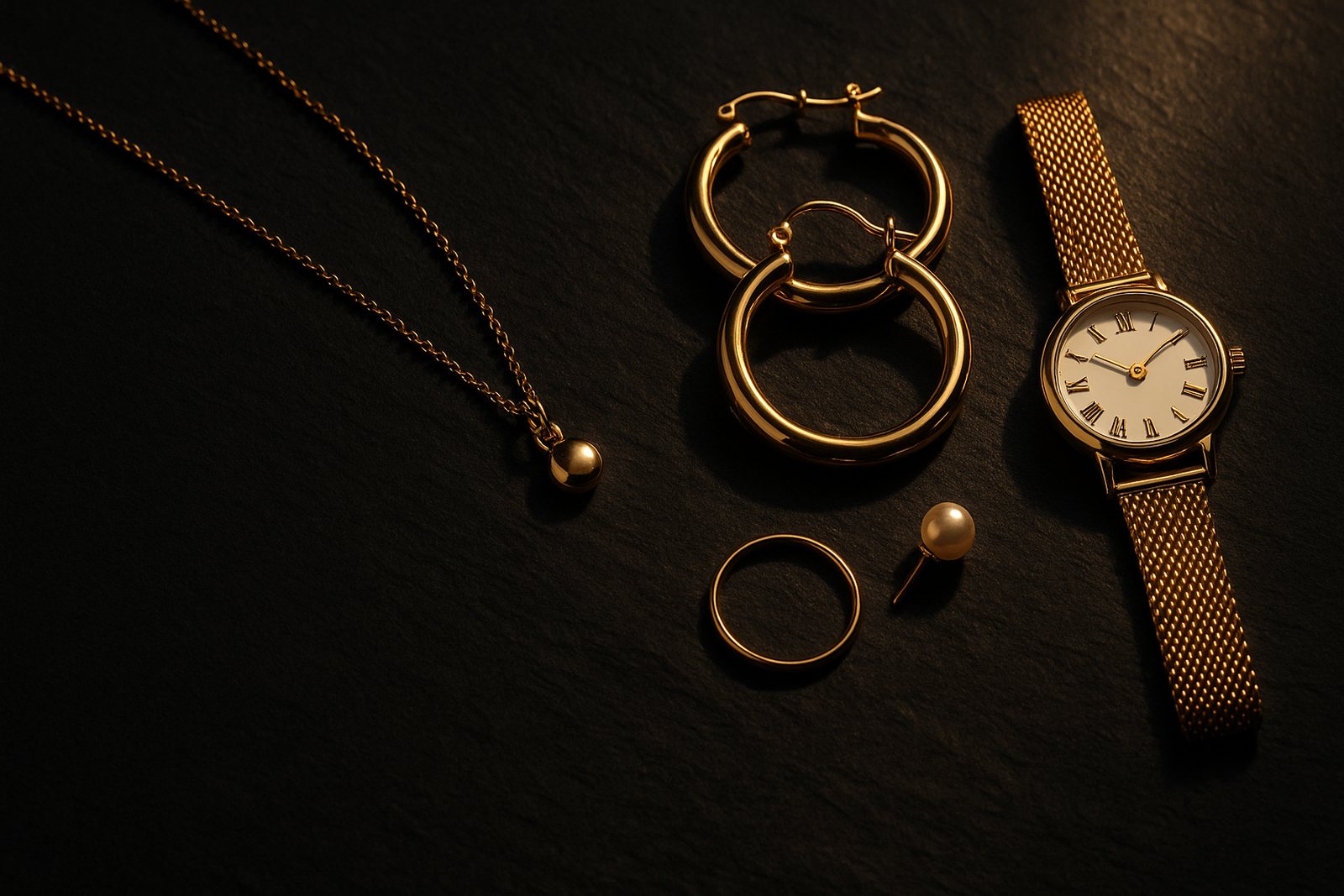
The fastest way to make coordinated bridesmaid jewellery look intentional is to fix a single metal tone across the group. Silver, gold and rose gold each work beautifully; mixing them — unless you are deliberately going for an eclectic aesthetic — rarely photographs well because the different tones create visual noise rather than harmony.
Gold reads as warm and formal, and works across most dress colours. Silver is cooler and particularly effective with slate, sage, ice blue or ivory fabrics. Rose gold has a romantic, slightly vintage quality that suits dusty pink, blush, champagne and terracotta palettes especially well. Whichever you settle on, communicate it to all bridesmaids early — it affects which earrings they choose even when you are not buying those yourself.
Plated, sterling or solid: For a one-day event, high-quality gold-plated pieces are perfectly practical. The important check is the base metal: brass or copper plating can cause reactions on skin around the neck, where fabric is not buffering contact. Sterling silver with rhodium plating or a solid sterling base is the safer call for anyone with sensitive skin. If ordering gold plating, look specifically for gold vermeil — a thicker layer of gold over sterling silver — rather than anything listed only as "gold tone" or "gold colour."
Thin plating on a pendant can flake or tarnish noticeably in outdoor light — exactly when wedding photographs are taken. Never buy any piece described only as "gold colour" without further material detail. Look for tarnish-resistant finishes, gold vermeil, or rhodium plating noted in the product description. A piece that looks polished in a product photo can disappoint sharply in person if the plating layer is too light.
Getting lengths right matters more than most people realise before they hold the piece. UK and European sizing conventions can differ from US ones, so always verify the actual measurement in centimetres rather than relying on names like "matinee" or "opera," which vary between retailers.
| Name | Approximate length | Where it sits on the body |
|---|---|---|
| Choker | 35–40 cm | Base of the throat |
| Princess | 43–50 cm | Collarbone to just below |
| Matinee | 55–60 cm | Between collarbone and bust |
| Opera | 70–90 cm | At the bust or lower |
| Rope | 90 cm + | Can be doubled or looped |
For most UK bridesmaid dresses — typically midi or floor-length with a scoop or V-neck — a princess-length necklace is the safe default. It suits the widest range of necklines, does not get caught in updos, and scales from very simple to fairly ornate depending on the pendant choice.
If your bridesmaids' dresses vary in neckline (common when the couple has given bridesmaids a colour and let them choose their own style), specifying a length range — say, anything between 43 and 55 cm — is more practical than a fixed number. Within that range, each person can find what works for her neckline.
Once you have fixed the metal and length, the surface of the necklace is where bridesmaids can express a little individuality without breaking the overall look.
Cubic zirconia (CZ) catches the light very well in photographs and costs considerably less than diamond, making it the practical choice for a group purchase. Look for secure settings: bezel-set stones (where the metal wraps fully around the stone) sit flush and are far less likely to snag dress fabric than prong-set alternatives. This matters especially during dancing, when prong settings catch easily on fine fabrics.
Freshwater pearls suit virtually every dress colour and have a timeless quality that photographs beautifully. Real freshwater pearls show slight natural variation in colour and shape — that is the sign of authenticity, not a defect. Faux pearls (typically glass or plastic) look more uniform but appear noticeably flatter in close-up photographs. For a wedding where photos matter, the real thing usually wins.
Plain chains — a simple trace, figaro or cable chain with no pendant — are the lowest-risk option when you are unsure how a pendant will interact with a particular neckline or fabric. The emphasis falls entirely on the quality of the metal and finish, so look for a smooth, even surface and a reliable clasp mechanism.
Statement pendants should be tested against the actual dress fabric and colour before committing to a group order. What looks elegant in a flat product photo can appear heavy or mismatched in person, particularly against lightweight chiffon or heavily textured fabrics.
The coordinated-not-cloned approach has a practical version many couples use: buy one defining element the same — typically a necklace at a fixed metal tone and approximate length — then allow bridesmaids to choose their own earrings or add a personal charm. The group photographs still read as "matching"; the bridesmaids feel like individuals rather than a matching set.
Some couples give bridesmaids a brief rather than a specific piece: a metal tone, a maximum length, and a rough aesthetic note such as "delicate" or "no coloured gemstones." A brief is more flexible than issuing identical pieces and sidesteps the challenge of finding one piece that genuinely suits five different tastes and face shapes. It works especially well for larger parties, or when bridesmaids are covering part of their own costs.
A third option is to buy identical necklaces but personalise with each bridesmaid's initial or birthstone on an interchangeable pendant. The base piece reads as uniform in photographs; the personal element means something to the individual. This approach works best when all bridesmaids are a similar height and the necklace length is generous enough to sit well on everyone.
Buying jewellery for four or more people simultaneously introduces risks that a solo purchase would not.
Order from one batch. Colour consistency in plating and stone quality can vary even within the same product listing if pieces come from different manufacturing runs. Where possible, buy a pack sold as a matched set rather than the same item ordered individually multiple times — sets are matched before packaging and are considerably more consistent in tone.
Allow time for returns. Order at least six weeks before the wedding for standard pieces; eight to ten weeks for anything engraved or personalised. That window covers initial delivery, time to inspect pieces against the dress in person, and a return-and-reorder cycle if something is wrong.
Check for an extender chain. A clasp with 4–5 cm of spare chain at the end allows the necklace to sit at different points on the neck without any alteration. This is not universal — confirm the listing mentions it explicitly, because a fixed-length chain that sits too short cannot be fixed on the morning of the wedding.
Order one spare. For a group of four or more, a single extra piece costs relatively little and removes a significant stress point. Clasps break, boxes go missing in hotel rooms, and having a spare in the bag keeps a small problem small.
Check the clasp type. Spring-ring clasps are small and fiddly — particularly hard to open with a full set of nails or in a hurry before the ceremony. Lobster clasps are significantly easier to manage one-handed. Toggle clasps look beautiful but can open under the weight of a pendant during a full day of movement, making them better suited to bracelets than necklaces.
Getting these details confirmed before clicking buy removes most of the risk from what is otherwise a very straightforward category to shop. Good bridesmaid jewellery does not need to be expensive — it needs to be consistent, well-fitted to the dress neckline, and robust enough to last a full wedding day without fuss.


At least six weeks before the wedding for standard pieces — eight to ten weeks for anything personalised or engraved. This window covers the initial delivery, time to inspect pieces against the dress in person, and a return-and-reorder cycle if something is wrong. Ordering early also gives access to a wider range of stock, since popular styles can sell through quickly during the UK summer wedding season.
Giving every bridesmaid the same necklace in the agreed metal tone, then letting each choose her own earrings, usually produces the strongest cohesive look in photos while respecting individual style. Alternatively, set a brief — metal tone, maximum length, rough aesthetic — and let bridesmaids choose within it. The brief approach works well for larger parties where tastes and budgets differ significantly between members.
A princess-length necklace — approximately 43 to 50 cm — is the most reliable choice. It sits at or just below the collarbone, flattering the exposed neckline without competing with the dress. For something slightly more dramatic, a matinee-length chain falling between the collarbone and bust also works well. Avoid very long opera-length pieces with strapless styles, as they can visually flatten the silhouette rather than elongate it.
Real freshwater pearls offer genuine lustre at a fraction of the cost of saltwater varieties, hold up well to a full day of wear, and photograph noticeably better than faux alternatives. Faux pearls — typically glass or plastic — look flat in close-up shots, which matters when the photographer is capturing detail shots. Slight natural variation in colour and shape confirms authenticity; perfectly uniform pearls in an affordable set are almost always faux.
As an Amazon Associate we earn from qualifying purchases. Prices and availability are accurate as of the date shown and are subject to change — the price on Amazon at checkout is the one that applies.
Coordinate bridesmaid jewellery without buying identical pieces — UK guide to necklines, metal tones, necklace lengths and what to
Find the most flattering earrings for your face shape. A practical UK guide to oval, round, square, heart, oblong and diamond face
A practical UK guide to necklace lengths: what the measurements mean, how to match them to your neckline and proportions, and what